The 5 Elements
5 elements? – shouldn’t that be 4 elements?
In Western culture and philosophy, we have been familiar since antiquity with the doctrine of the four elements:
Air • Fire • Earth • Water
According to the teachings of Greek natural philosophers—most notably Empedocles in the 5th century BC—the world is composed of these four fundamental elements. He describes them as immutable “roots” or primordial forces that exist eternally. And although they are states that do not change in themselves, everything that exists comes into being and passes away through the interplay of love and strife between these elements. They are also associated with—among other things—states of matter, temperaments, and colours:
| ELEMENT | STATE OF MATTER | TEMPERAMENT | COLOUR |
| air | gaseous | sanguine | yellow |
| fire | all consuming | choleric | red |
| earth | solid | phlegmatic | green |
| water | liquid | melancholic | blue |
Far Eastern philosophy (Taoism) describes five elements:
Wood • Fire • Earth • Metal • Water
These five elements do not represent static states but rather ongoing, dynamic processes. They are interconnected and can strengthen or control one another, or even weaken and damage each other.
The changes in nature throughout the year are examples of such dynamic processes and are viewed as nature’s phases of transformation. We call them the seasons. Each season is associated with one of the five elements, which influence the rhythms, development, and needs of all living beings.
Wood
… is the element of spring and follows the winter’s resting phase in the cycle (see also “Water” below). It encompasses the rising of vital fluids and new beginnings. Wood is associated with the liver and gallbladder—organs that cleanse our body with their secretions, thereby making room for the new. In nature, wood represents growth, expansion, and the upward flow of vital fluids. It describes the process of setting out and stands for new beginnings and creativity. The stage of life associated with this element is childhood and early youth.
Fire
… marks the peak of the cycle and represents the element of summer.
It reflects the dynamism, exuberance, and abundance of colour characteristic of this season.
It embodies heat, vitality, radiance, joy, and liveliness. The organs associated with this element are the heart and the small intestine. Both organs sustain life and nourish the entire organism: the small intestine, which separates nutrients from waste and makes them available to the body; and the heart, which supplies the entire organism with vital substances via the blood while simultaneously expelling waste products through the lungs. The dynamic interplay between these two organs generates vitality and liveliness. The life stage associated with this element is late adolescence and young adulthood—a time when the things that “lie close to our hearts” are of particular importance to us.
Earth
… is the element of late summer and early autumn.
It is the season when the process of ripening—from seed to fruit—reaches completion. Fruit forms, plant sap descends into the earth, and leafes change color. The Earth element is associated with the stomach and spleen. These organs transform the food we consume so that our bodies can utilise it, acting in a balancing and nurturing way. Earth represents transformation—such as the metamorphosis into fruit—as well as the nourishment it yields and a sense of enveloping warmth and care. At the same time, it stands for stability and centeredness. Through these essential qualities, Earth characterises mature adulthood—the stage of life when we build a family.
Metal
… is the element of autumn—the season we associate with the processes of withdrawal, maturity, and letting go.
In TCM, the organs associated with this element are the lungs and the large intestine—two organs closely linked to the processes of letting go and elimination. Metal is clear and sharp; it can both protect and wound. It represents contraction, clarity, and letting go. In nature, it manifests, for example, as the crisp sharpness of an autumn morning or the sound of a gong. Its essential qualities include mindfulness and honesty, but also grief.
Recognising one’s own values and self-worth—including how we set boundaries with others and present ourselves to the outside world—gives us a certain degree of firmness, but above all, it provides structure.
The corresponding stage of life is the onset of old age.
Water
… occupies the lowest position in the cycle, serving as its resting terminal point and origin. It is an essential component of any dynamic process and represents the element of Winter (see also my January 2024 newsletter). Winter is the season of pausing and stillness, of withdrawal and letting go, but also of gathering strength. In TCM, the associated organs are the kidney and the bladder—here, too, the focus is on letting go, cleansing, and regeneration. Water can be deep and calm, yet also turbulent and stirring. It symbolizes reflection, contemplation, regeneration, and taking stock of a situation, as well as wisdom and the withdrawal associated with old age. At the same time, it represents conception, the beginning of life, and willpower. Water stands at both the end and the beginning of the cycle; it is here that the forces needed for a (fresh) start—for spring—are gathered. The corresponding stage of life is advanced old age.
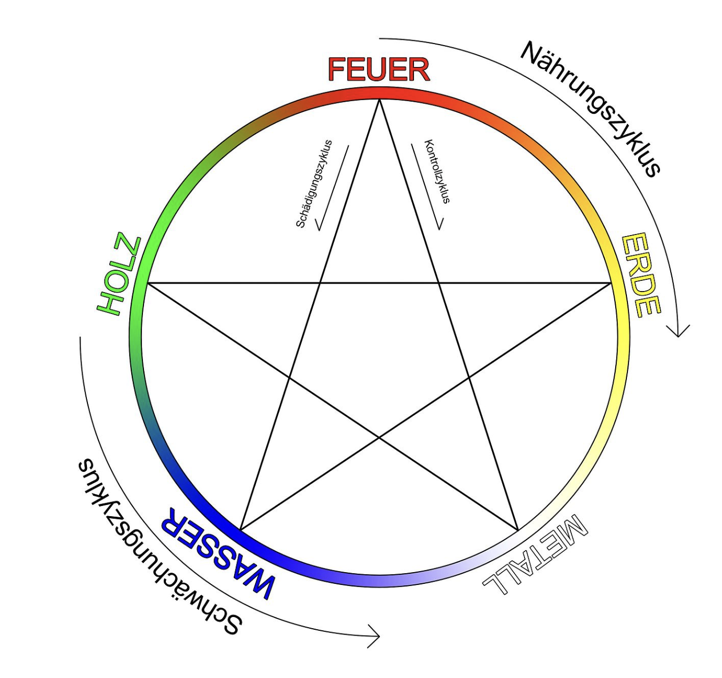
In the Five-Element theory, we observe the factors that allow these phases of transformation and processes to flow, or conversely, those that weaken and inhibit them—refer to the image above.
This is described in terms of cycles:
- Nourishing cycle and weakening cycle
- Control cycle and damaging cycle
Nourishing cycle (generation): Wood nourishes Fire; Fire nourishes Earth (ash); Earth produces Metal (minerals); Metal collects (in vessels) and nourishes (mineralizes) Water; and Water enables Wood to grow.
Running counter to this is the weakening cycle (each element draws sustenance by weakening its predecessor): Wood absorbs Water; Water corrodes Metal; Metal extracts minerals from Earth; Earth stifles Fire; and Fire burns Wood.
Control cycle (regulation): Each element keeps another in balance so that no single force becomes dominant: Fire controls Metal (forging); Metal controls Wood (axe); Wood controls Earth (roots support the soil); Earth controls Water (e.g., dike construction); and Water controls Fire (extinguishing).
Running counter to this is the damaging cycle (which acts destructively and harmfully): Fire evaporates Water; Water softens Earth (erosion); Earth stifles Wood; Wood dulls Metal; and Metal controls Fire.
The seasons and their associated elements not only shape the natural world around us but—since we are part of that nature—also influence our own bodies.
In Traditional Chinese Medicine (TCM), the body is not viewed in isolation but as part of a larger, all-encompassing organism. We are connected to this system via the chakras—centers through which energy flows into and out of our bodies. This energy circulates through our bodies along energy pathways known as meridians, connecting the various organs with one another. Thus, the five elements also describe the processes and functions within the body. The organs are interconnected via the meridians; they can nourish and control one another, but also weaken or damage each other.
We can influence whether we live in harmony with these cycles or against them—for instance, through our diet, meditation, movement, and breathing. Yin Yoga offers further support in this regard; I have described this in more detail here.